
Pianist, composer, teacher and ethnomusicologist, Béla Bartók was one of the great modern figures of the early 20th century. Dive into the world of this visionary creator, celebrated by Bozar and the Belgian National Orchestra during the Bartók Festival from 6 to 12 February.

1. A difficult childhood for a child prodigy
Born in 1881 in a small Hungarian town (today in Romania), Bartók grew up in a family of amateur musicians. His musical gifts appeared very early, but his childhood was marked by illness: until the age of six, he lived largely isolated from other children.
2. A patriotic spirit
Bartók developed in a historical context shaped by the domination of the Russian, German and Austrian empires. At the end of the 19th century, Brahms and Wagner ruled musical life. Bartók began to question the weight of the German heritage: how could one compose music that was truly Hungarian?

3. Singing villages
After meeting the composer Zoltán Kodály, Bartók deepened his interest in Hungarian folk music and organized his research using rigorous methods. Armed with a phonograph, he travelled through the countryside from village to village, collecting thousands of songs. After Hungary, he continued his work among neighbouring peoples, gathering Slovak and Romanian melodies, and even travelled as far as Turkey and Algeria.
This approach would later be known as ethnomusicology, the discipline that studies the music of ethnic groups and cultural communities around the world.
4. His music
Initially influenced by Strauss, Liszt and Brahms, and later by Debussy, Bartók ultimately found his true path through the discovery of folk melodies. From the encounter between folklore and art music emerged a unique musical language, later enriched by the influences of Stravinsky and Schoenberg.
5. Piano teacher
In 1907, Bartók was appointed to the Royal Academy of Budapest, where he taught for most of his life. He was a piano teacher, but never a composition teacher: piano technique belongs to everyone; composition was his alone.
6. The King of Swing
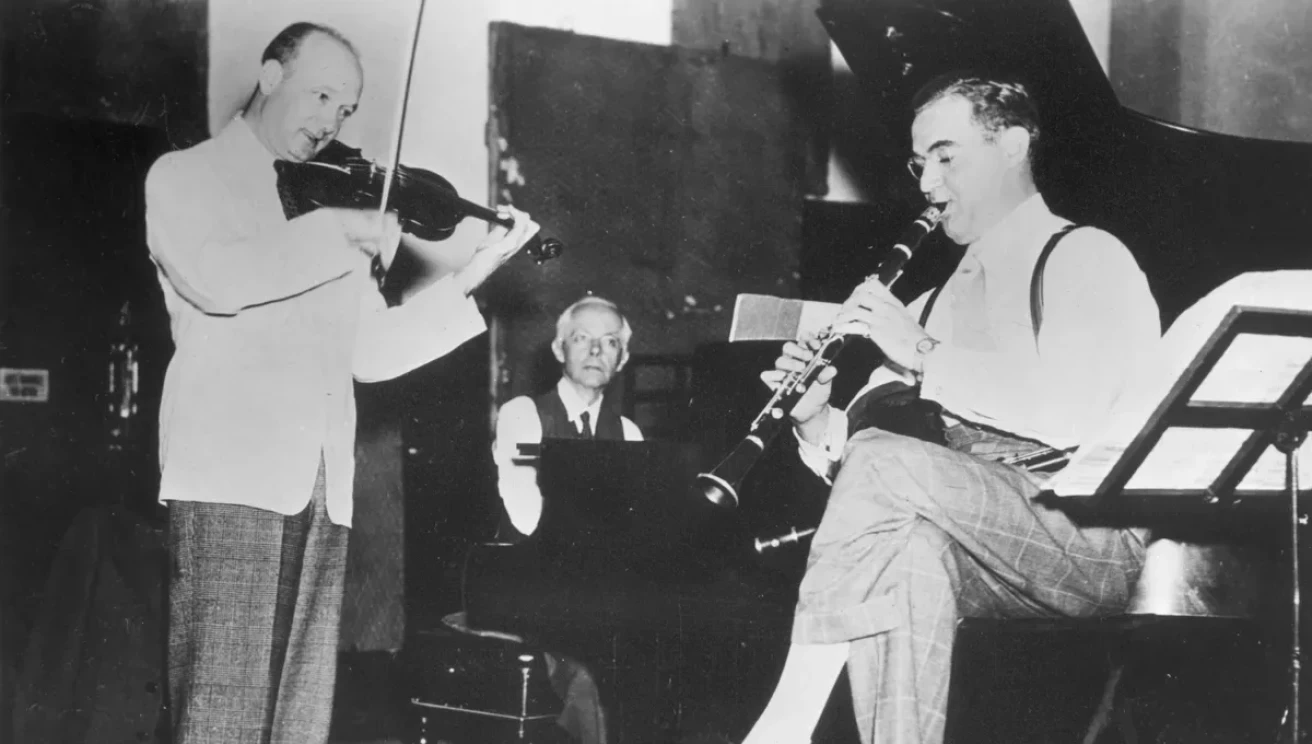
In 1938, Benny Goodman, the celebrated jazz clarinettist best known for Sing Sing Sing, commissioned a work from Bartók. The result was Contrasts, a striking piece whose premiere took place at Carnegie Hall in New York. Listen to it here.
7. Anxiety
During the 1930s, the rise of Nazism deeply troubled Bartók. His letters are permeated with anxiety. He contemplated leaving not out of fear, but out of revulsion for fascism. He changed publishers when his became aligned with Nazism, refused to have his works performed at Nazi concerts, and stipulated in his will that no street or square should bear his name as long as any still carried the name of Hitler or Mussolini.

8. Bartók in Brussels
As fascism gained ground, Bartók travelled increasingly often to Brussels for stays of varying length. There he met the Antwerp musicologist Denijs Dille, who would devote much of his life to preserving and promoting Bartók’s musical legacy. Thanks to his work, the Royal Library of Belgium now holds an extensive archive dedicated to Bartók.
Brussels also honours the composer with a statue on the Place d'Espagne (Spanish Square). Created by sculptor Imre Varga, it was donated by the city of Budapest in 1995, on the 50th anniversary of Bartók’s death.
9. Exile
At the beginning of 1940, as the threat of war in Europe grew ever more pressing, Bartók decided to emigrate to the United States. He died in exile in 1945, still full of ideas and projects. “It is a great pity that I must leave while my suitcase is still full.”
10. Legacy
Bartók’s legacy extends far beyond his work as a composer. Through his recordings and transcriptions of folk music, he paved the way for modern ethnomusicology. Synthesising the musical currents of his time without ever submitting to them, Bartók created a language that is both deeply personal and universal—one whose influence continues to resonate in today’s music.


